
The Mossy Nib
Future Wilderness
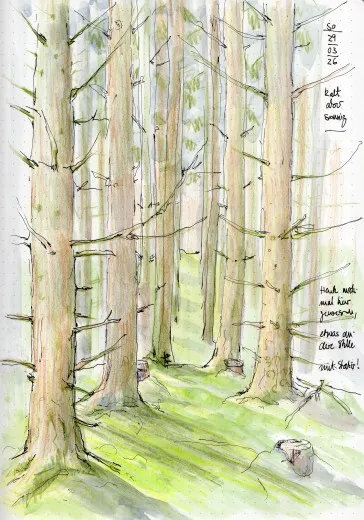
Wilderness?
Six thousand years ago, 80% of Europe was covered in forest; by 2021, that figure had fallen to 40%. That may still sound like a lot, but it's important to note that over 90% of these forests are used for commercial forestry, and today there are only a few areas left in Europe (0.2%) that can be described as primeval or primary forest.
Primary forests are forests that have never been used for forestry: today they are found mainly in Scandinavia and the Carpathians; smaller areas can also be found in the Alps, the Pyrenees and the Apennines. Incidentally, a disproportionately large proportion of the world’s primary forests is found in areas inhabited by indigenous peoples. This is the case not only on the African continent, in the Amazon region or in North America, but also here in Europe: the last remaining primeval forests in northern Scandinavia, for example, are largely the habitat of the Sami people.
In Germany, only tiny remnants are now classified as primary forest: these are generally areas that have always been too difficult to access to be exploited, such as the cliff edge on the island of Rügen with its beech stands.
So there are no longer any true primeval forests in Germany. Instead, there are increasing efforts to create new wilderness areas. The Bavarian Forest National Park is one such example of a ‘future wilderness’. It is Germany’s oldest national park and was designated a protected area in 1970. Human intervention there is to be kept to an absolute minimum. A primeval forest must be rich in species as well as structure; in other words, it must not only contain a great many different animals and plants, but there must also be a wide range of trees of varying ages. As a rule, it takes over 600 years for the age distribution of the trees to reach a state that is approximately natural. However, the process of regeneration begins immediately as soon as dead wood is left lying on the ground.
(sources: Global Forest Review, Greenpeace, Wikipedia, WWF, NABU, ZEIT-Artikel)
The Bavarian Forest was Germany’s first national park; there are now 16 in total. In addition, numerous other conservation measures have been and continue to be developed. The German Federal Nature Conservation Act distinguishes between the following conservation measures:
National parks:
- over 10,000 hectares,
- protected areas,
- protection of large, largely undisturbed natural landscapes,
- no management: nature is left to its own devices,
- divided into core and buffer zones,
- research and low-impact tourism permitted,
- example near me: Eifel National Park (11,000 hectares)
Wilderness areas:
- often form part of a national park or biosphere reserve,
- protection of natural processes (human intervention is prohibited),
- the aim is to restore or preserve a high level of species and habitat diversity,
- often larger than 100 hectares,
- Management plan stipulates the removal of infrastructure,
- In Aachen, for example, the "Freyenter Wald": 60 hectares of woodland with old oak and ash stands south of Aachen, parts of which have long been a nature reserve and have been protected since 1988; the NRW Foundation and NABU acquired the site in 2019 and are allowing it to develop into a wilderness area
Nature reserves:
- often smaller than national parks,
- the most common form of strict nature conservation in Germany
- conservation areas,
- the aim is to maintain and develop habitats, species and biotopes,
- use is permitted only if it does not jeopardise conservation,
- together with national parks and natural monuments, they are among the most strictly protected areas
Natural monuments:
- a relatively new category (2010),
- considerably smaller than national parks, but subject to similarly strict protection,
- an example is the "Ivenacker Oaks" in Mecklenburg-Western Pomerania, a 1,000-year-old historic forest covering 75 hectares; not a primeval forest but a pasture forest (woodland pasture, i.e. livestock were sent to graze beneath the oaks)
Nature parks:
- managed landscapes,
- shaped by human activity,
- consist mainly of nature and landscape conservation areas, but are managed,
- Example in my neighbourhood: the High Fens and the Eifel
FSC certification and deadwood
However, even forests used for commercial forestry can be managed more sustainably: since 2003, the Aachen Forest has been certified with the Forest Stewardship Council (FSC® -C116663) environmental label, following an initiative by Greenpeace. This certification can be regularly renewed through sustainable forestry, which is intended to make the forest more multi-layered and species-rich, and, for example, increase the proportion of native tree species. In addition, 5% of the total forest area is designated as ‘reference areas’ and set aside. This means that these sections are no longer used for forestry, and dead wood is left lying here too. I found a sign about this in one spot:
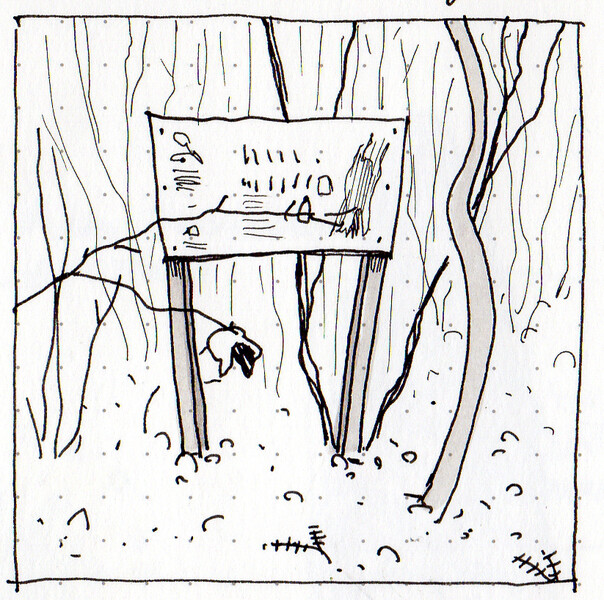
It informs concerned and particularly law-abiding german hikers that dead trees and branches are deliberately left in place, and explains why this makes ecological sense for the forest and the environment. It also warns of falling branches. To ensure that no one reports seemingly particularly negligent forest rangers to the public order office, there are additional explanations online in which the forest office explains the procedure. It concludes with the words:
The local forest office has long supported the formation of standing and fallen dead wood in the forest, (...). As a result, not every piece of wood in the forest is sold as firewood, and the forest may appear somewhat untidy. This is not due to negligence on the part of the ranger, but rather a deliberate form of forest management. The forest has its own rules of order!
sources: www.aachen.de/in-aachen-leben/natur-freizeit/aachener-wald/totholz, www.aachen.de/in-aachen-leben/natur-freizeit/aachener-wald/stilllegungsflaechen
I just found that hilarious - and a really good thing - and hopefully it will help people to get used to the sight. Because even though a ‘conventional’ forest may at first glance appear soothing and peaceful to the human eye (as in the cover illustration), it is often, in fact, a monoculture. Trees standing in neat rows, with a canopy so dense that it barely lets any sunlight through, meaning that hardly anything can grow beneath them apart from moss.
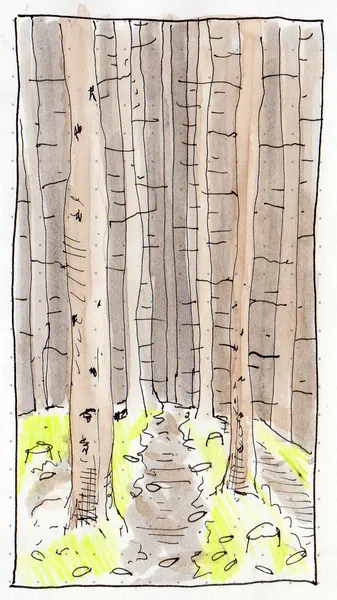
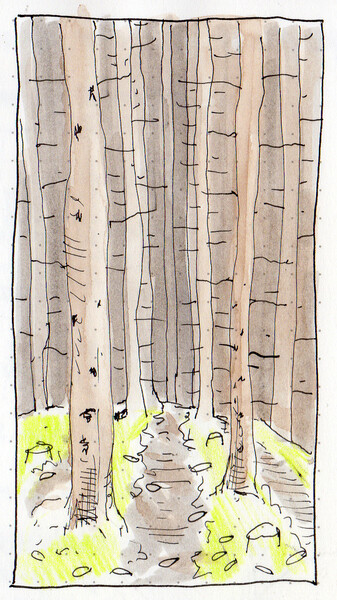
In my example, it was spruce trees. Spruce grows naturally in only a few regions of Germany, yet it is also the most widespread conifer. It is the most important source of forestry income, but is associated with forests that are particularly species-poor and unnatural. You can easily tell if they are spruce trees by the numerous cones scattered on the ground. Spruce cones fall off whole and look like this:
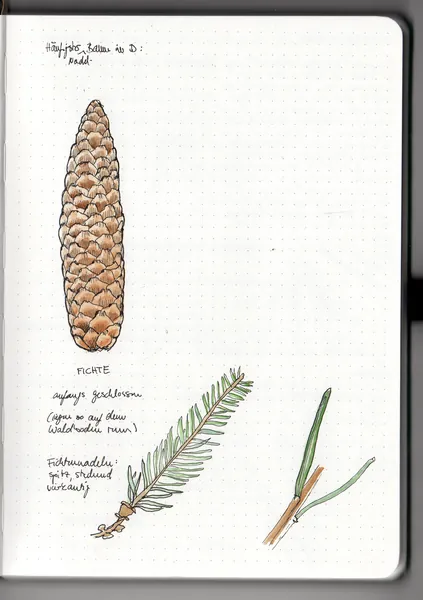
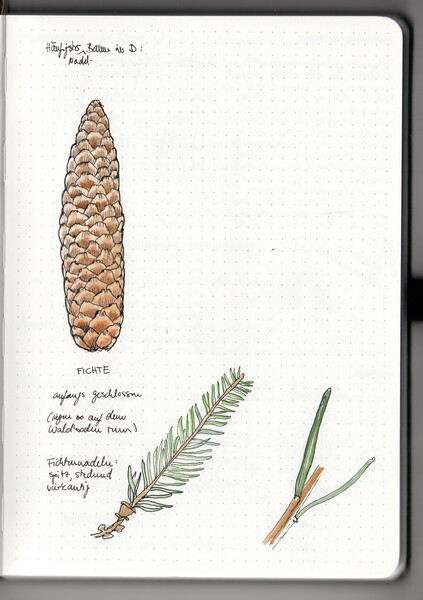
(I’ve left some space on the page for a drawing of the cone once it has opened)
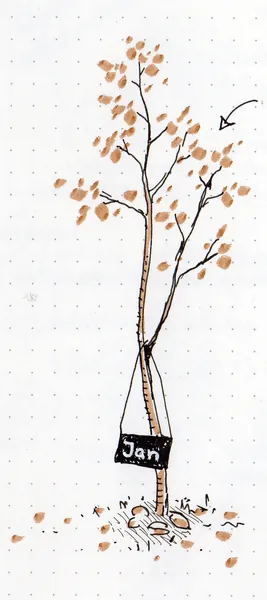
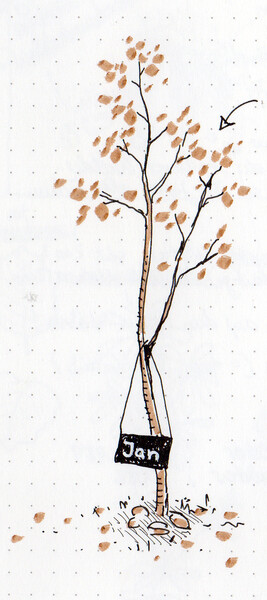
A little further on, whilst out for a walk, I came across lots of small young beech saplings, which inspired me to write this blog post. Some of them still had name tags attached. Apparently, for the past few years there have been planting initiatives where Aachen residents can plant a young tree from a forest nursery themselves in return for a donation:
In theory, deciduous forests should be growing everywhere here, yet in 2017, for economic reasons, 55% of Germany’s forests still consisted of conifers. However, these monocultures were unable to withstand climate change effectively: hotter summers and increased drought took a heavy toll on spruce trees, as did bark beetle infestations. They also struggled to withstand storms, as they have shallow root systems. According to a 2024 report, only one in five trees is now considered healthy, with spruce and pine monocultures particularly affected, compounded by the frequent forest fires of recent years. Since then, a shift has begun towards more mixed woodland, which is more resilient under these conditions.
(sources: NABU, Aktion Baum)
That’s why I was delighted to see these little trees with their plates around their necks – a clear sign, even right here on my doorstep, of a shift towards greater biodiversity and a general change in mindset.
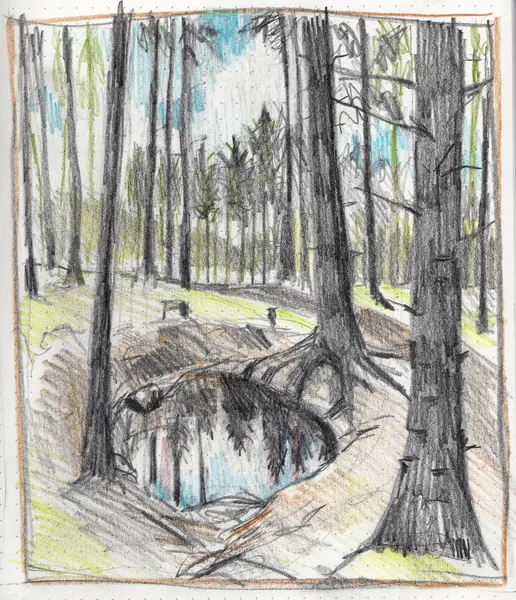
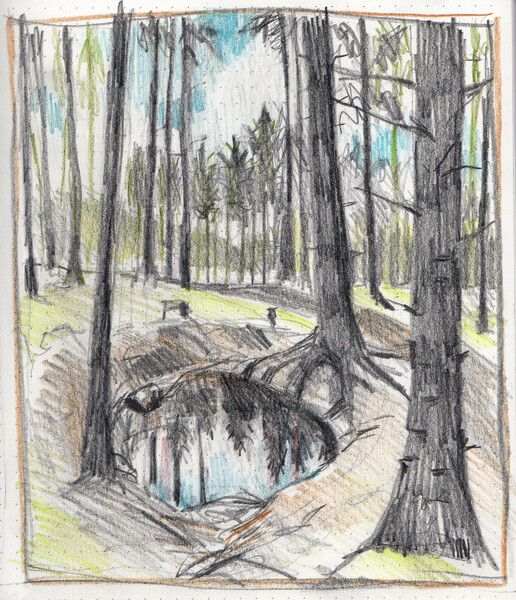
And sometimes I come across things in the woods that I can’t quite explain, but which are simply fascinating, like this little round pool in the woods. Is it an old bomb crater? Did the Romans dig here for clay or loam? Did it form naturally through ice or water? I don’t know, but it always looks amazing:
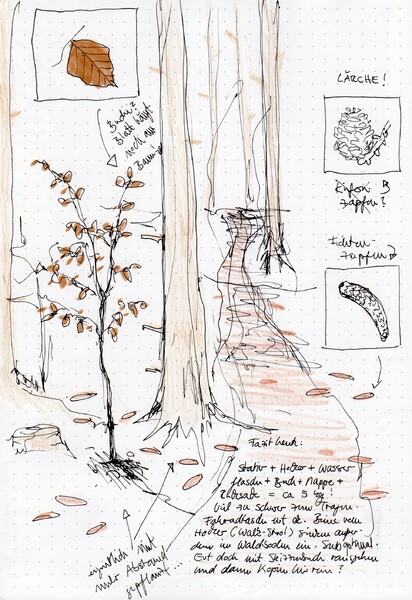
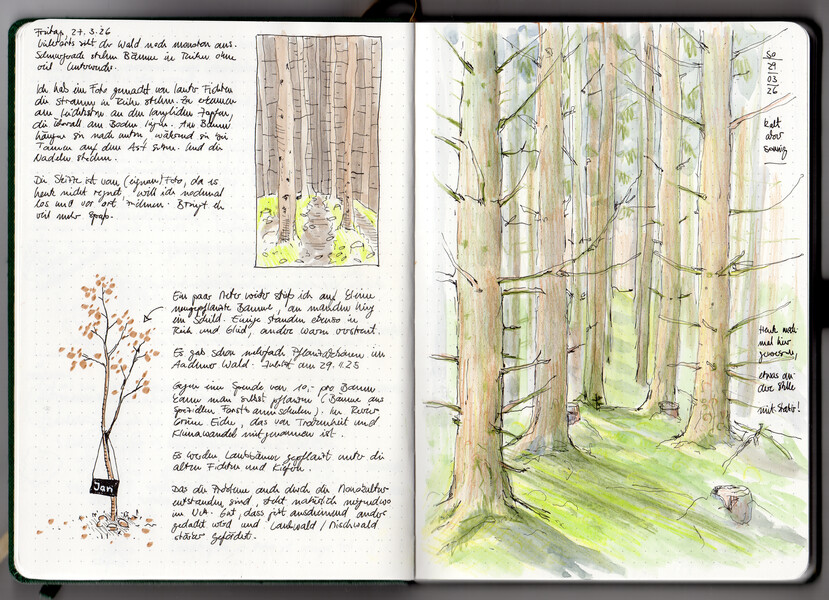
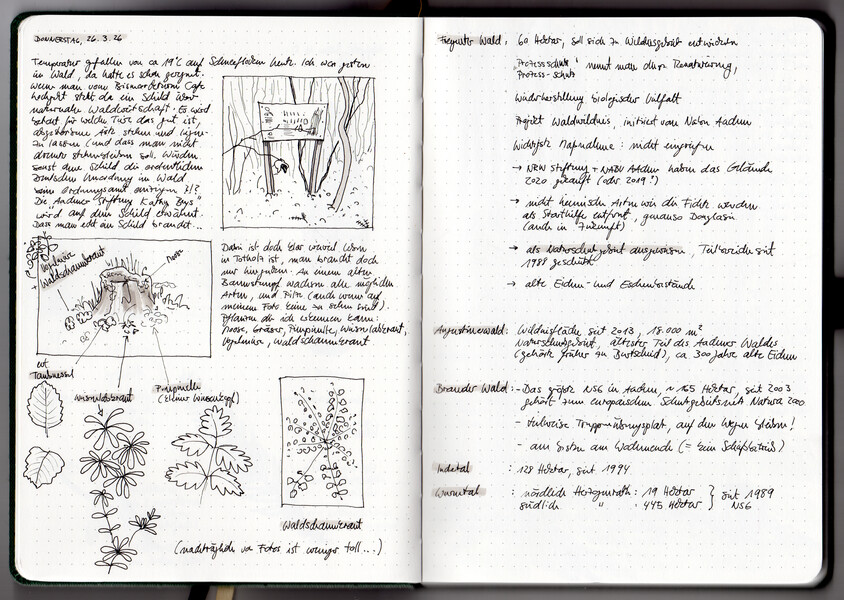
I#d like to finish this post with a few sample pages just as they appear in my sketchbook. More direct, handwritten and just as ‘messy’ as the forest is at its most beautiful. And there are a few notes on the kit and its weight, too, but that’s a topic for another day :)
Best wishes, Imme
P.S.
If you happen to be in Germany: there’s an exhibition at the Gasometer Oberhausen running until the end of the year on the theme of ‘Forest Worlds’, which is definitely worth a visit. I haven’t been there myself yet, but I definitely plan to go: www.gasometer.de/de/ausstellungen/mythos-wald



Imke Sönnichsen © 2026 | Template © 2009-2026 by modified eCommerce Shopsoftware